Buffer Views in Evergine
Not every improvement in a graphics engine immediately translates into new visual effects or features that stand out at first glance. Some improvements are more related to the engine architecture itself, how resources are managed internally, and how the engine can continue evolving without increasing system complexity.
The introduction of Buffer Views in Evergine is one of those improvements.
This new capability is designed to provide more flexible access to GPU data, allowing the same buffer to be reused in different ways without duplicating memory or creating additional resources. While it may sound like a low-level technical detail, its impact on rendering, compute workflows, and the future evolution of the engine is significant.
Separating storage from access
One of the common challenges in modern graphics pipelines is that the same set of GPU data often needs to be consumed in different ways depending on the shader, the pipeline stage, or the system using it.
Traditionally, this usually led to less efficient solutions: creating dedicated buffers for each use case, generating intermediate copies, or tightly coupling the physical memory layout to how the data would later be consumed. All of this added more memory usage, more complexity, and more maintenance overhead.
Buffer Views introduce a much more flexible approach.
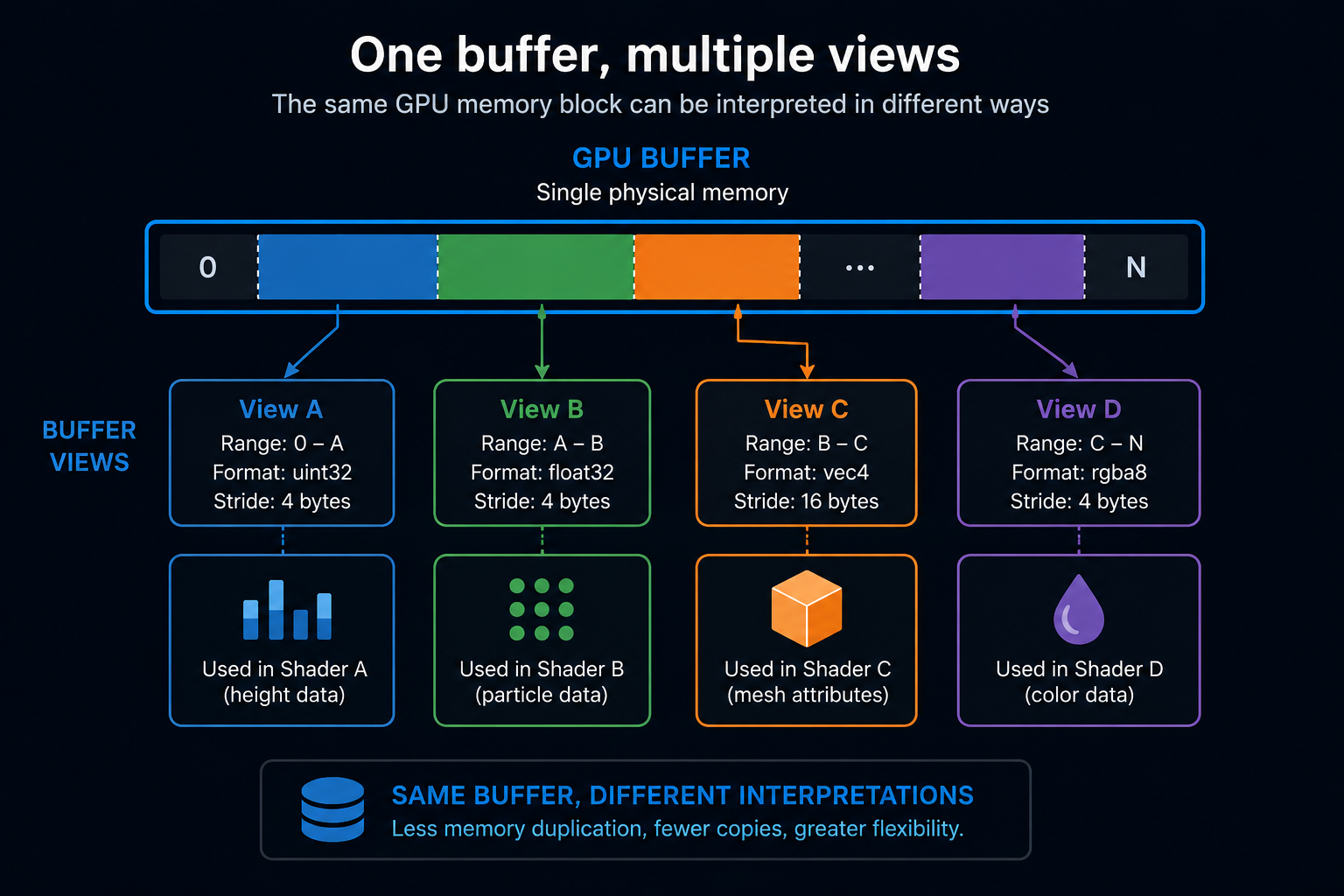
Instead of working directly with the entire buffer, it is now possible to create views over a specific region of that buffer while also defining how those bytes should be interpreted from the shader side. In other words, the physical storage remains the same, but the way the data is accessed can vary depending on the context.
Put simply, the same GPU memory block can now be reused in multiple ways without replicating resources.
Native integration inside Evergine
The implementation of Buffer Views was not designed as an isolated feature, but as a fully integrated improvement inside Evergine’s resource system.
Internally, the engine now includes a common abstraction for defining buffer views, including consistency validation for offsets, sizes, formats, and stride definitions. This ensures that every view remains valid and coherent regardless of the graphics backend being used.
ResourceFactory has also been extended to support creating Buffer Views through a unified and expressive API. Starting from a base buffer, developers can define subranges, typed formats, or structured layouts depending on the needs of each shader or pipeline.
Additionally, the bindings system and ResourceSet have been updated to work directly with these views, introducing specific resource types for read-only and read-write access (TexelBuffer and TexelBufferReadWrite).
All of this integrates seamlessly with the engine’s existing GPU state and barrier management systems.
This functionality is already implemented across all major graphics backends supported by Evergine, including DirectX 11, DirectX 12, Metal, OpenGL, Vulkan, and WebGPU. This ensures consistent behavior regardless of the target platform or graphics API, something especially important for multiplatform projects and industrial environments where portability is a key requirement.
A practical example
To validate the implementation, a new sample was also added to our internal low-level graphics tests.
The sample generates 64 random 32-bit values inside a single GPU buffer. From that same memory block, two different Buffer Views are created: one interprets the data as uint32 values, while the other reuses exactly the same bytes as rgba8 colors.
The result is a visualization of vertical bars where one view controls the height of each bar while the other defines its color, all while reusing the exact same physical buffer.
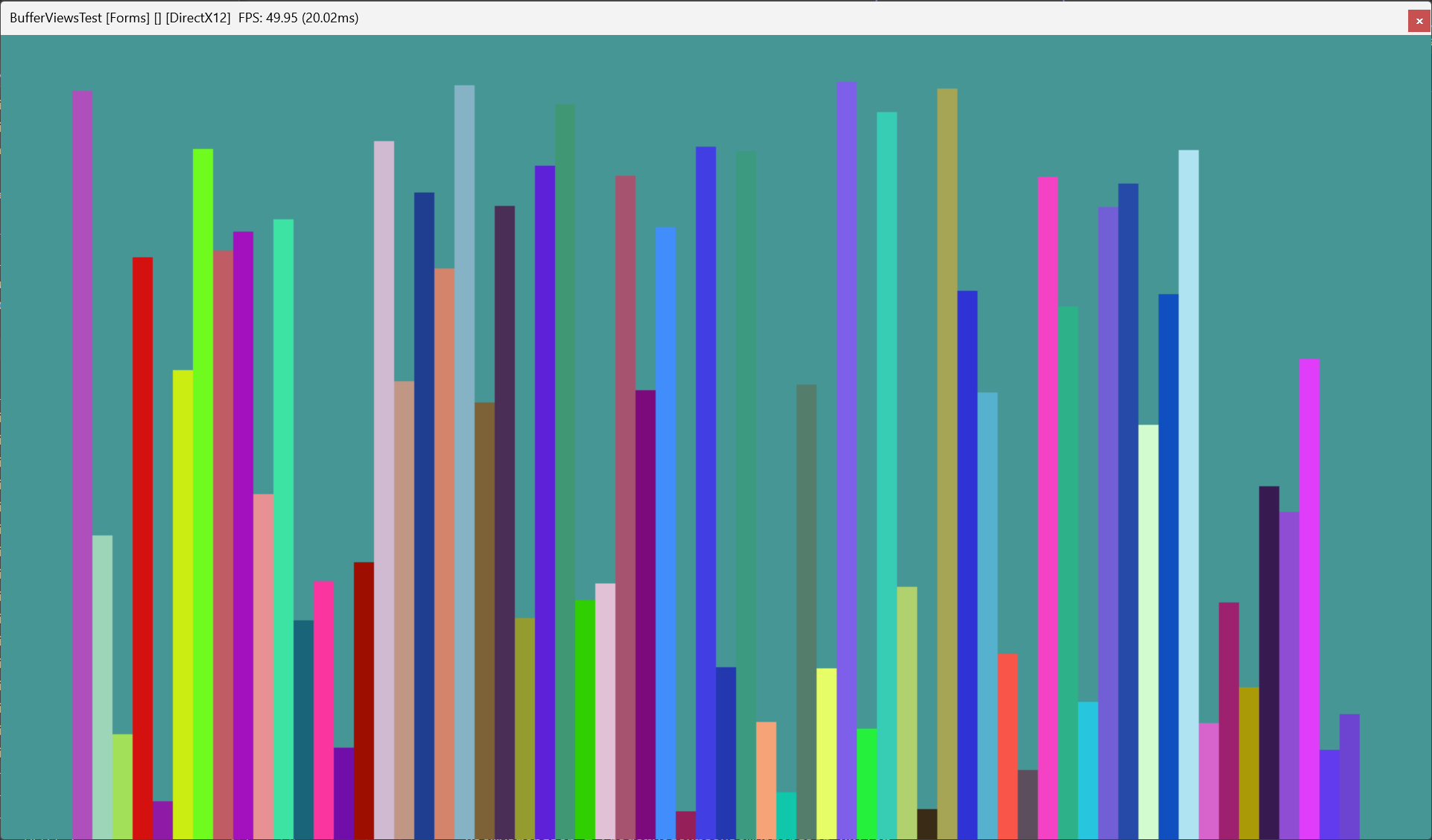
It is a simple example, but it perfectly illustrates the main purpose of Buffer Views: completely separating data storage from data interpretation.
Besides reducing unnecessary duplication, this approach also makes it much easier to build pipelines where rendering and compute systems efficiently share the same data.
More flexibility for modern pipelines
The main value of Buffer Views lies in the flexibility they provide when building modern rendering and compute pipelines.
It is now much easier to reuse large shared buffers across different systems, work with specific subranges, or reinterpret data depending on the exact needs of each pipeline stage.
This not only reduces resource duplication, but also lowers memory pressure and removes many intermediate copy operations that were previously needed to reorganize data.
From a development perspective, it also simplifies the evolution of future graphics features. Changing how a shader consumes information no longer necessarily requires redesigning the entire memory layout associated with it.
The result is a cleaner, more maintainable architecture that is better prepared to continue evolving.
A feature designed for the future
Even though Buffer Views are mainly an internal improvement, they represent very well the kind of evolution we continue pursuing in Evergine: building a more flexible, efficient, and future-ready technology foundation for modern graphics pipelines.
Many advanced rendering techniques increasingly depend on efficiently sharing data between rendering and compute stages. Separating storage from access is a key step in that direction, reducing technical friction while also providing a more expressive API for developers.
Ultimately, Buffer Views are not just another feature. They are a structural improvement that strengthens the engine architecture and opens the door to new possibilities for optimization and resource reuse inside Evergine.