New features in Gaussian Splatting Add-on
In this new Evergine release, we continue to push forward the Gaussian Splatting add-on, introducing two significant new capabilities: support for the SOG compressed format and full WebGPU rendering support. These additions bring greater storage efficiency and prepare the add-on for next-generation rendering pipelines.

Recap about 3D Gaussian Splatting
3D Gaussian Splatting is a sophisticated technique in computer graphics that creates high-fidelity, photorealistic 3D scenes by projecting points, or “splats,” from a point cloud onto a 3D space, using Gaussian functions for each splat. This technique supports complex view-dependent visual effects and surpasses traditional point cloud rendering by producing dynamic and lifelike visualizations.
3D space is defined as a set of Gaussians, with each Gaussian’s parameters calculated through machine learning.
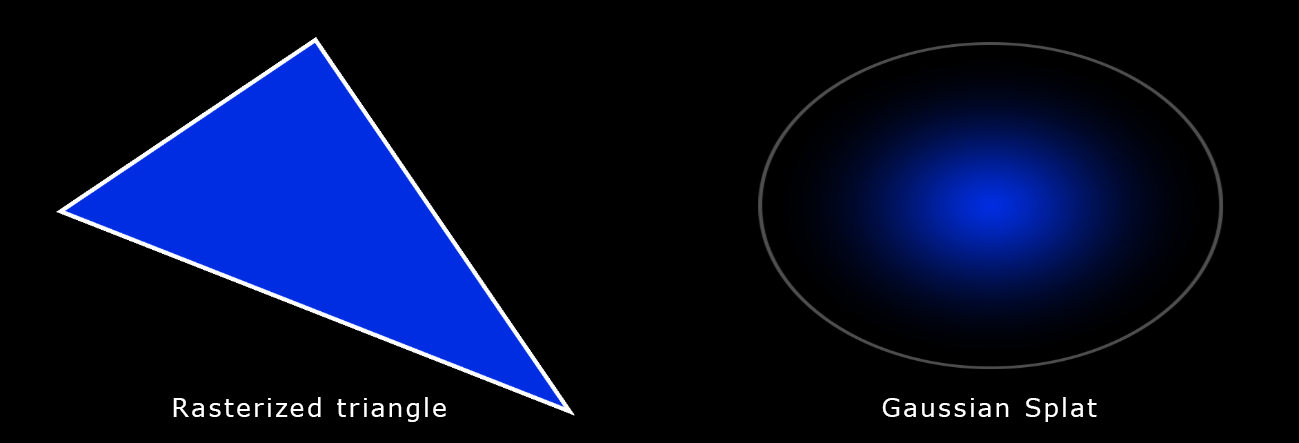
It is analogous to triangle rasterization in computer graphics: instead of drawing triangles, Gaussians are used. Each Gaussian is described by its position, covariance, color, and alpha.
New Features
This Evergine release brings important new capabilities to the Gaussian Splatting add-on, expanding format support and rendering backend flexibility.
SOG Format Support
The add-on now supports the SOG format developed by PlayCanvas, a highly compressed Gaussian Splatting file format whose name stands for Spatially Ordered Gaussians. It is based on the research paper “Compact 3D Scene Representation via Self-Organizing Gaussian Grids” (Morgenstern et al., ECCV 2024) from Fraunhofer Heinrich Hertz Institute. PlayCanvas adopted and popularized this format, making it practical for real-time web deployment.
How SOG works: Gaussians as textures
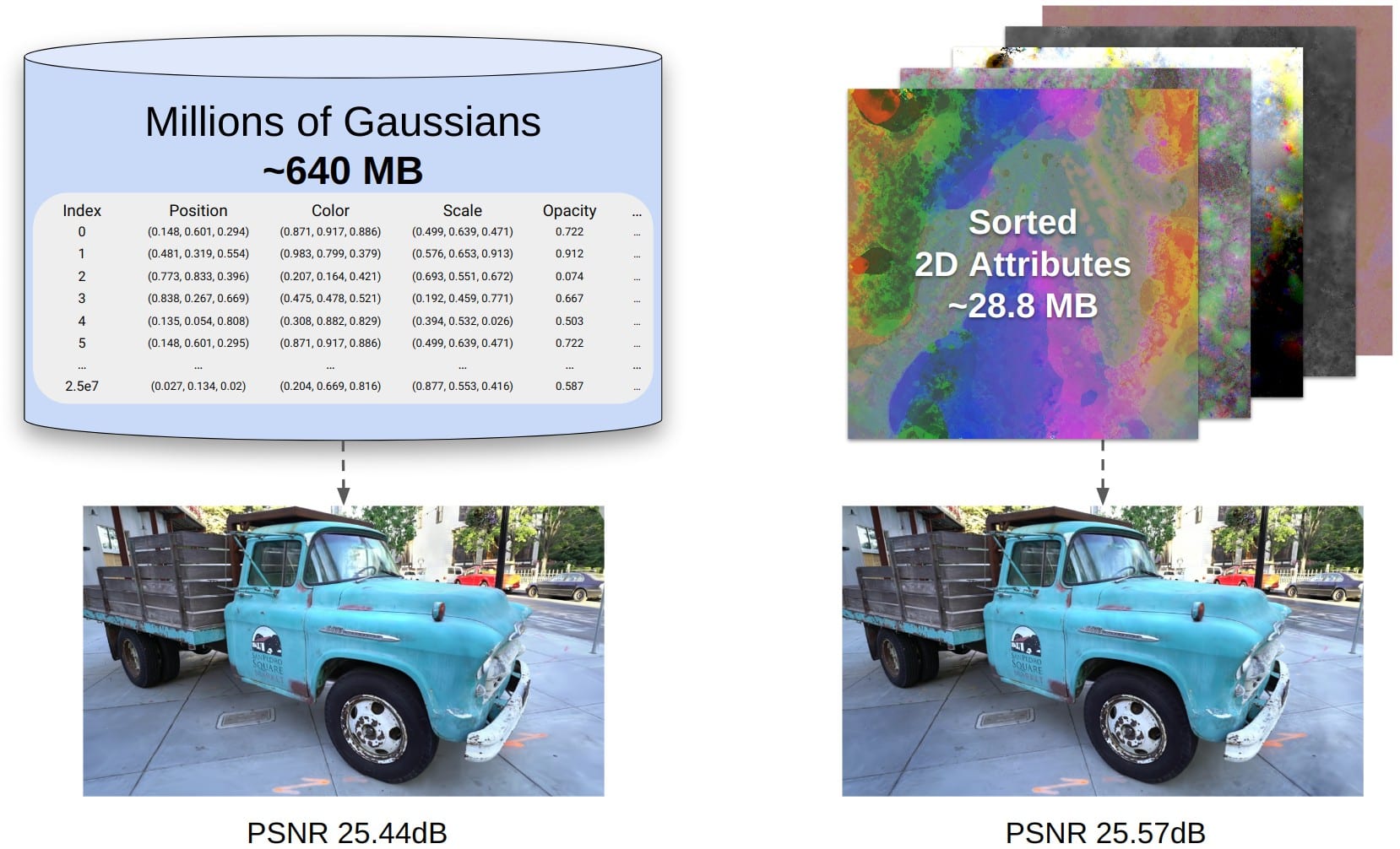
The key insight behind SOG is that all the data describing a Gaussian Splatting scene (positions, colors, transparency, and the complex view-dependent lighting information known as Spherical Harmonics) can be laid out into regular 2D images, much like textures in a video game. Once the scene data is organized this way, standard image compression (the same kind used for JPEGs or PNGs) can compress it extremely efficiently, since image codecs are highly optimized for exactly this type of structured, spatially coherent data. The result is a file that is a fraction of the size of other formats, with negligible loss in visual quality.
Why SOG is better than compressed .ply
A key limitation of the compressed .ply format is that, while it quantizes splat positions, scales, rotations, and base colors, it does not compress the Spherical Harmonics (SH) coefficients. Spherical Harmonics encode view-dependent color effects, meaning how the appearance of a splat changes depending on the viewing angle, and they account for a very significant portion of the total file size, especially for scenes captured with high SH degree.
Because SOG stores all parameters including SH as 2D grid images, it compresses SH coefficients just as efficiently as the rest of the data, using the same image compression pipeline. This is the main reason for its dramatic size advantage.
The main advantages of the SOG format are:
- Texture-based storage: all Gaussian parameters are organized into 2D grids and compressed as images, enabling the reuse of highly optimized image compression technology.
- Spherical Harmonics (SH) compression: unlike the compressed .ply format, SOG fully compresses the SH coefficients, which are the single largest contributor to file size in high-quality captures.
- Significantly smaller file sizes: the combination of grid organization, local smoothness enforcement, and image compression achieves reduction factors of 19.9× to 39.5× over vanilla 3DGS, and ~5× over compressed .ply, while maintaining visual quality.
- Simple decoding: decompressing a SOG file requires only standard image decompression followed by a rescaling pass, with no complex codebooks or neural networks needed.
- Faster load times: smaller files translate directly into faster asset loading, improving the end-user experience, especially in streaming scenarios.
- Web and mobile friendly: the compact representation makes SOG an ideal choice for deploying Gaussian Splatting scenes in resource-limited environments.
Real-World Size Comparison
To illustrate the impact, here is a real example using the same scene exported to each format. The compressed .ply is used as the baseline:
| Format | File Size | Notes |
| CarmonaRomanBridge.ply (original) | 691.3 MB | Raw uncompressed 3DGS output, ~3.9× larger |
| CarmonaRomanBridge.compressed.ply (baseline) | 179.5 MB | — |
| CarmonaRomanBridge.sog | 35.7 MB | SOG file, ~80% smaller (~5× smaller) |
The SOG format saves ~80% of the storage compared to the already-compressed .ply, a reduction entirely driven by Spherical Harmonics compression, something the compressed .ply format simply does not support.
WebGPU Rendering Support
The Gaussian Splatting add-on can now use WebGPU as its rendering backend. This was not a trivial addition: it required work on two fronts simultaneously. On one side, the Gaussian Splatting add-on itself was updated to support WebGPU rendering paths, adapting its sorting, buffer management, and draw calls to the WebGPU API. On the other side, certain areas of the Evergine WebGPU backend were also fixed and improved to ensure everything worked correctly together.
Benefits of WebGPU for Gaussian Splatting
- Modern GPU access: WebGPU provides low-level, explicit GPU control similar to Vulkan and Metal, enabling more efficient use of GPU resources during splat sorting and rendering.
- Better performance on supported platforms: On platforms and browsers that support WebGPU, this backend can deliver improved frame rates and lower CPU overhead compared to WebGL-based rendering.
- Future-proof architecture: As WebGPU adoption grows across browsers and platforms, this investment ensures that Evergine’s Gaussian Splatting capabilities will remain relevant and performant in the evolving web ecosystem.
- Foundation for upcoming features: WebGPU unlocks compute shader capabilities that will be essential for future enhancements to the add-on.
What’s Next
We are actively working on bringing even more advanced rendering capabilities to the Gaussian Splatting add-on in future releases.
Stochastic Rasterization
One of the most exciting areas under active development is stochastic rendering for Gaussian Splatting, based on the research paper “StochasticSplats: Stochastic Rasterization for Sorting-Free 3D Gaussian Splatting” (Kheradmand et al., ICCV 2025). It proposes a fundamentally different approach to how splats are composited on screen.
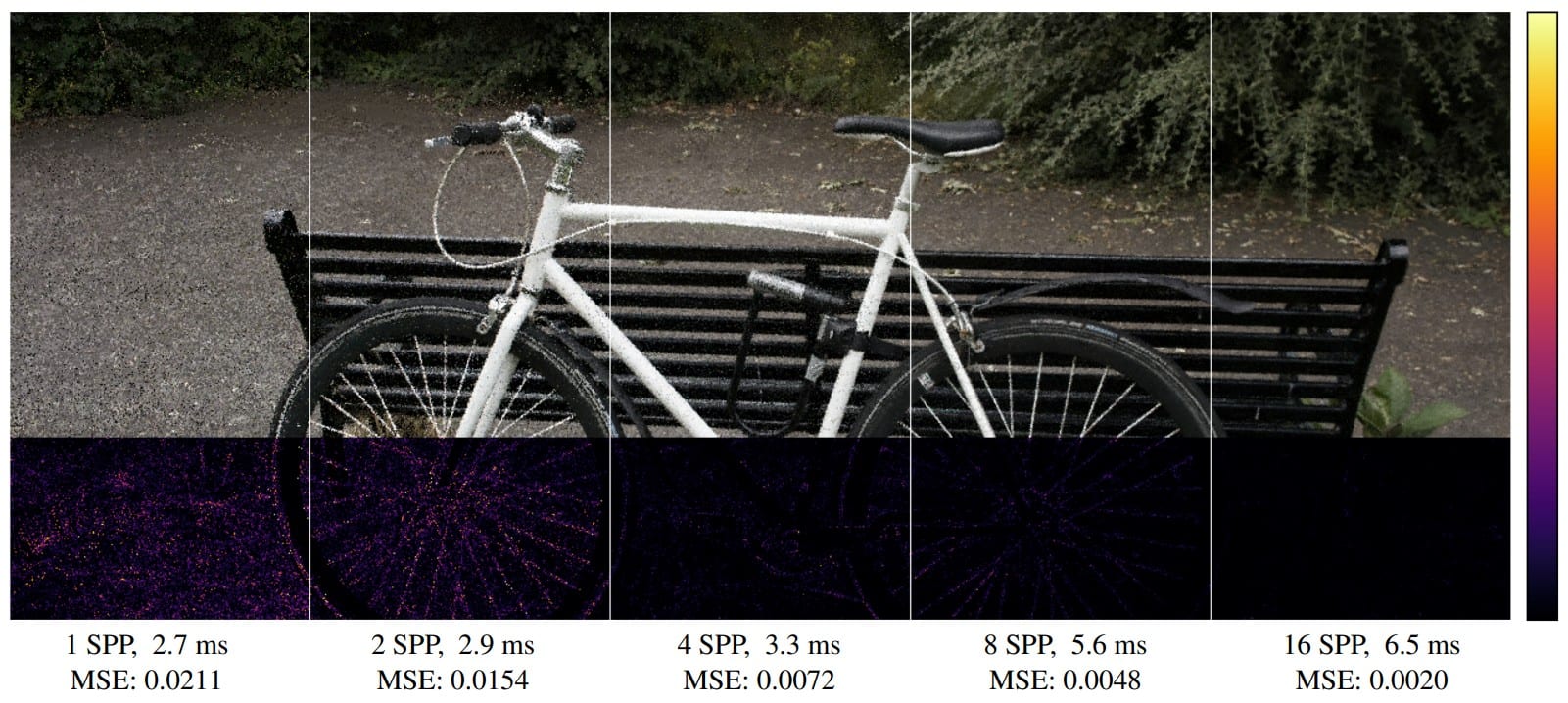
Traditional Gaussian Splatting rendering relies on alpha blending, which requires all splats to be sorted back-to-front relative to the camera before each frame. This sorting step is computationally expensive and can become a bottleneck for large scenes, especially at high frame rates.
Stochastic rendering takes a completely different approach:
- No sorting required: Splats do not need to be sorted before rendering, eliminating one of the main performance costs of classic Gaussian Splatting.
- No alpha blending: Instead of blending semi-transparent layers, stochastic rendering uses a form of stochastic transparency combined with dithering and specialized shading effects to achieve a visually equivalent result.
- Order-independent: The final image is consistent regardless of the draw order of the splats, greatly simplifying the rendering pipeline.
- Higher performance potential: By removing the sort dependency, this approach opens the door to better GPU parallelism and higher sustained frame rates in complex scenes.
It is also worth noting that the adoption of WebGPU as a rendering backend opens the door to a higher-quality stochastic rendering solution. We look forward to sharing more details as this feature matures.
Conclusion
This release brings two major steps forward for the Gaussian Splatting add-on: native support for the compact SOG format from PlayCanvas, with its key advantage of full Spherical Harmonics compression, and the ability to render Gaussian Splatting scenes using the WebGPU backend. Together, these additions make the add-on more versatile, more efficient, and ready for the future of real-time 3D rendering. And with stochastic rendering on the horizon, the best is yet to come.
Author: David Ávila Membrives, Senior Staff Researcher